

Chlorfenapyr24%SC
Control of many species of insects and mites, including those resistant to carbamate, organophosphate and pyrethroid insecticides and also chitin-synthesis inhibitors, in cotton, vegetables, citrus, top fruit, vines and soya beans. Among pests resistant to conventional products which are controlled by chlorfenapyr are Brevipalpus phoenicis (leprosis mite), Leptinotarsa decemlineata (Colorado potato beetle), Helicoverpa spp.

Chemistry Identity
CAS NO.: 122453-73-0
Molecular Structure
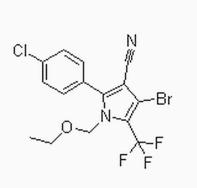
Common name: Chlorfenapyr
Toxicity
Oral Acute oral LD50 for male rats 441, female rats 1152 mg tech./kg.
Skin and eye Acute percutaneous LD50 for rabbits >2000 mg/kg.
Moderate eye irritant; Non-irritating to skin (rabbits).
Inhalation LC50 for rats 1.9 mg tech./l air.
Other Non-mutagenic in the Ames, CHO/HGPRT, mouse micronucleus
and unscheduled DNA synthesis tests.
Toxicity class WHO (A.I.) II
Storage
Keep in cool and dry place, for 2 years.
Application
Control of many species of insects and mites, including those resistant to carbamate, organophosphate and pyrethroid insecticides and also chitin-synthesis inhibitors, in cotton, vegetables, citrus, top fruit, vines and soya beans. Among pests resistant to conventional products which are controlled by chlorfenapyr are Brevipalpus phoenicis (leprosis mite), Leptinotarsa decemlineata (Colorado potato beetle), Helicoverpa spp., Heliothis spp., Plutella xylostella (diamond-back moth) and Tetranychus spp. Also control of many species of structural and household Formicidae (especially Camponotus, Iridomyrmex, Monomorium, and Solenopsis), Blattellidae (especially Blatta, Blattella, Periplaneta and Supella spp.), Kalotermitidae (especially Incisitermes) and Rhinotermitidae (especially Reticulitermes, Coptotermes, Heterotermes) at use rates of between 0.125 to 0.50% a.i. w/w.
Molecular Structure
Common name: Chlorfenapyr
Toxicity
Oral Acute oral LD50 for male rats 441, female rats 1152 mg tech./kg.
Skin and eye Acute percutaneous LD50 for rabbits >2000 mg/kg.
Moderate eye irritant; Non-irritating to skin (rabbits).
Inhalation LC50 for rats 1.9 mg tech./l air.
Other Non-mutagenic in the Ames, CHO/HGPRT, mouse micronucleus
and unscheduled DNA synthesis tests.
Toxicity class WHO (A.I.) II
Storage
Keep in cool and dry place, for 2 years.
Application
Control of many species of insects and mites, including those resistant to carbamate, organophosphate and pyrethroid insecticides and also chitin-synthesis inhibitors, in cotton, vegetables, citrus, top fruit, vines and soya beans. Among pests resistant to conventional products which are controlled by chlorfenapyr are Brevipalpus phoenicis (leprosis mite), Leptinotarsa decemlineata (Colorado potato beetle), Helicoverpa spp., Heliothis spp., Plutella xylostella (diamond-back moth) and Tetranychus spp. Also control of many species of structural and household Formicidae (especially Camponotus, Iridomyrmex, Monomorium, and Solenopsis), Blattellidae (especially Blatta, Blattella, Periplaneta and Supella spp.), Kalotermitidae (especially Incisitermes) and Rhinotermitidae (especially Reticulitermes, Coptotermes, Heterotermes) at use rates of between 0.125 to 0.50% a.i. w/w.
Technical sheet
| Chlorfenapyr24%SC | |
|---|---|
| Appearance | |
| Content of a.i. | ≥24% |
| pH | 4月7日 |
| Suspensibility | ≥90% |
| Wet sieve(45um) | ≥98% |
| Storage stability | Qualified |
Order